Customers today expect fast, accurate, and personalized support every time they reach out to a business. Traditional call centers, built around manual processes and human-only teams, struggle to keep up with rising expectations and fluctuating demand. That is where an ai powered contact centers changes the game.
By combining artificial intelligence, automation, and human expertise, including specialized capabilities like ai for itsm and AI-driven insights for customer engagement, modern AI-powered call centers deliver better experiences at lower cost while giving teams the tools they need to perform at their best. This guide explores how these next-generation technologies come together to transform customer service, operations, and business performance as a whole.
Expanding the Capabilities of an AI-Powered Call Center Through Modern Intelligent Technologies
As AI-powered call centers evolve, they rely on a broader ecosystem of modern intelligent technologies that enhance performance, scalability, and customer experience. One foundational element is intelligent cloud-driven automation, which combines distributed computing with AI to securely manage large volumes of interactions in real time. This ensures faster processing, higher uptime, and seamless support even during unexpected call surges.
AI-powered environments also benefit from next-generation digital systems engineering, a technology layer that strengthens how data, voice, and operational tools come together. With more advanced computing frameworks in place, support teams gain more reliable workflows, better routing accuracy, and smoother integrations with business platforms.
On the business side, organizations use smart promotional intelligence systems to optimize engagement across customer touchpoints. These AI-enhanced marketing capabilities help call centers predict customer needs, personalize outreach, and guide agents with contextual recommendations, reinforcing AI-driven insights for customer engagement without overwhelming teams.
To support revenue operations, modern call centers are increasingly adopting autonomous financial analytics engines, enabling leaders to forecast operational costs, evaluate performance trends, and identify opportunities for process improvement. These financial intelligence tools make AI-powered operations more strategic and cost-efficient.
Layered across all of this is adaptive enterprise support intelligence, a capability deeply aligned with ai for itsm. By blending IT service workflows with AI-driven automation, call centers can resolve technical issues faster, proactively prevent system disruptions, and keep customer experience consistently high.
Together, these advanced technologies form a unified ecosystem that strengthens every part of an ai powered call center, from customer engagement and marketing to operations, financial oversight, and IT service management. The result is a smarter, more responsive, and more scalable support environment built for today’s fast-moving customer expectations.
What Is an AI-Powered Call Center?
AnAI-powered call centeris a customer service operation that uses artificial intelligence to handle, support, or enhance customer interactions across voice and digital channels. Instead of relying solely on human agents, AI systems assist with tasks such as:
- Understanding customer intent throughnatural language processing
- Routing calls to the right agent based on skills and context
- Automating common requests with virtual agents or chatbots
- Providing real-time suggested replies or next best actions to human agents
- Analyzing interactions to uncover trends, sentiment, and improvement opportunities
AI does not replace humans entirely. Instead, it handles repetitive tasks, simple inquiries, and heavy data processing so that your human agents can focus on high‑value, complex, and emotionally sensitive conversations.
Top 10 Platforms Leading the Future of AI Powered Call Center Technology and Intelligent Customer Experience Automation
1. Bright Pattern
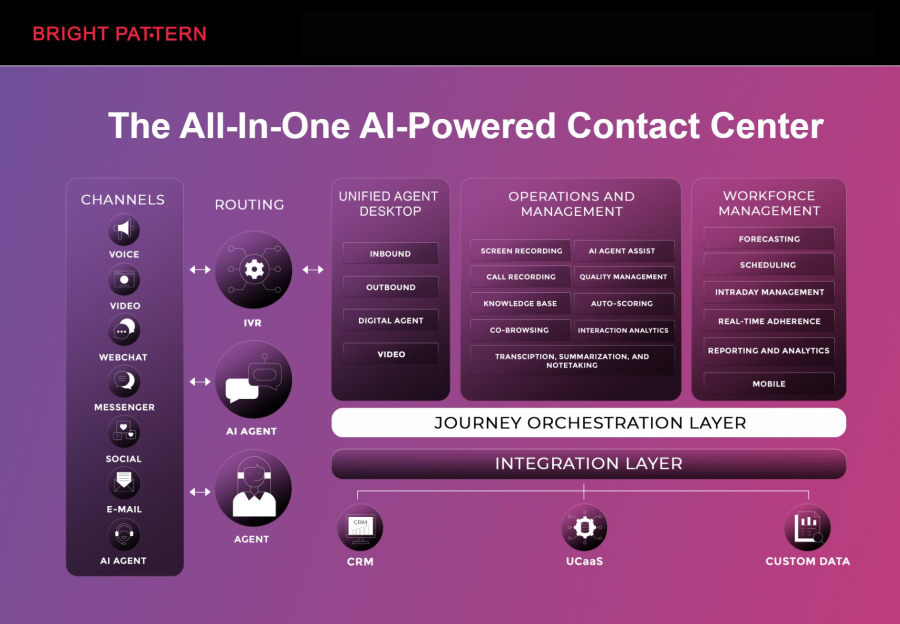
Bright Pattern stands at the top of the list because it delivers one of the most advanced and fully integrated AI-powered call center solutions available today. Built for speed, reliability, and omnichannel engagement, Bright Pattern combines conversational AI, intelligent routing, journey analytics, and human-to-AI collaboration tools in a single unified platform. The result is a seamless experience for both agents and customers, along with streamlined workflows that reduce cost and friction across the entire service operation. Bright Pattern’s strong focus on simplicity and integration makes it ideal for businesses that want powerful automation without unnecessary complexity.
Key Highlights of Bright Pattern
- Unified platform for voice, chat, SMS, email, and social channels
- Built-in conversational AI and automated routing
- Easy integration with CRM, ITSM, and enterprise systems
- Fast deployment and low total cost of ownership
- Proven reliability with enterprise-grade uptime
- Real-time analytics and journey optimization
- Scalable architecture ideal for growing support teams
2. Five9
Five9 offers a robust cloud-based customer service platform with AI-enhanced tools for automated routing, virtual agents, and workforce optimization. It is widely used by enterprise teams seeking strong AI and analytics capabilities.
3. NICE CXone
NICE CXone integrates AI, analytics, and omnichannel orchestration to help organizations deliver efficient customer experiences. Its advanced workforce engagement and automation capabilities make it popular among large enterprises.
4. Genesys Cloud CX
Genesys Cloud CX focuses on end-to-end digital and voice engagement powered by AI-based routing and predictive insights. It supports complex enterprise workflows and high-volume customer interactions.
5. Talkdesk
Talkdesk provides a scalable cloud contact center with AI-driven automation, quality management, and advanced routing. It is known for quick deployment and strong global availability.
6. Amazon Connect
Amazon Connect is Amazon’s cloud-based contact center solution, offering scalable AI tools like Amazon Lex and real-time analytics. It appeals to organizations already using AWS infrastructure.
7. Zendesk
Zendesk delivers AI-supported help desk and customer service workflows designed for both support teams and sales-focused organizations. It is highly flexible for growing customer service operations.
8. RingCentral Contact Center
RingCentral offers AI-enhanced call routing, workforce tools, and omnichannel management, ideal for businesses that want to unify communication and customer service in one ecosystem.
9. Oracle Service
Oracle Service delivers enterprise-grade automation, knowledge management, and AI-driven digital support. It is a strong solution for organizations with complex data and customer ecosystems.
10. Salesforce Service Cloud
Salesforce Service Cloud integrates AI through Einstein, enabling predictive insights, smart routing, and personalized customer journeys. It is especially effective for teams deeply invested in the Salesforce suite
Core Technologies Behind AI-Powered Call Centers
Several AI technologies work together to make an AI-powered call center effective. Understanding these building blocks helps you see where the value comes from.
1. Natural Language Processing (NLP)
Natural language processingenables machines to understand and interpret human language in real time. In call centers, NLP powers:
- Voicebots that understand spoken requests
- Chatbots that interpret text messages and emails
- Automatic speech recognition that converts speech to text
- Intent detection to determine what a customer is trying to achieve
The better the NLP, the more accurately the AI can respond, route, and support each interaction.
2. Machine Learning and Predictive Models
Machine learningallows systems to improve over time as they process more conversations. In an AI-powered call center, machine learning supports:
- Predictive routing, sending customers to the agent most likely to resolve their issue quickly
- Next best action suggestions based on similar past cases
- Identifying customers at risk of churn based on language and behavior
- Forecasting call volumes for smarter staffing and scheduling
3. Conversational AI and Virtual Agents
Conversational AIbrings together NLP, dialogue management, and business rules to build realistic, helpful virtual agents. These voicebots and chatbots can:
- Answer common questions 24/7
- Authenticate customers and gather information before handing off to humans
- Execute routine tasks such as balance checks, order tracking, or appointment booking
- Escalate to a human agent gracefully when needed
When designed well, conversational AI reduces friction for customers and frees human agents to focus where they add the most value.
4. Real-Time Analytics and Sentiment Analysis
Modern AI-powered call centers use real-time analytics to understand what is happening in every interaction.Sentiment analysisdetects customer mood and emotional tone, helping teams:
- Identify frustrated or at-risk customers quickly
- Trigger supervisor alerts for calls that need intervention
- Measure the impact of scripts, offers, or policy changes on customer sentiment
- Continuously refine training and quality standards
Key Benefits of an AI-Powered Call Center
AI in the call center is not just a technology upgrade; it is a strategic advantage. Here are the most impactful benefits organizations see when they embrace AI-powered operations.
1. Faster Response Times and Shorter Waits
Customers dislike being put on hold or waiting for a callback. AI addresses this directly by:
- Handling simple queries instantly through chatbots and voicebots
- Deflecting routine calls from live queues, reducing hold times for complex issues
- Streamlining verification and data collection before a human agent joins the call
The result is a noticeable drop in average handle time and time to first response, both key drivers of customer satisfaction.
2. 24/7 Availability Without Scaling Headcount
Offering round‑the‑clock support is expensive when you rely only on human staff. With AI:
- Virtual agents can assist customers at any hour, in any time zone
- Self‑service options stay available even when your human team is offline
- Critical issues can still be routed to on‑call teams when necessary
This always‑on capability improves customer trust and helps you win global customers without proportionally increasing labor costs.
3. Consistent, High-Quality Interactions
Human performance naturally varies from agent to agent and shift to shift. AI helps standardize and elevate quality by:
- Providing agents with real‑time guidance, scripts, and knowledge suggestions
- Ensuring policies, disclaimers, and compliance steps are followed in every call
- Monitoring 100% of interactions for quality issues, not just small samples
With AI oversight, you can maintain a consistent brand voice and service standard, even as teams grow quickly.
4. Higher First-Contact Resolution (FCR)
First-contact resolutionis a critical metric for both customer happiness and operational efficiency. AI improves FCR by:
- Routing customers to the best‑qualified agent or resource on the first try
- Surfacing full customer history and context automatically for agents
- Guiding agents to the most effective resolution based on similar past cases
More issues resolved in a single interaction means less follow‑up, lower costs, and a smoother experience for customers.
5. Lower Operational Costs and Greater Scalability
An AI-powered call center can absorb spikes in demand and routine workload more efficiently than traditional models. You benefit from:
- Reduced need to hire for peak seasons, as virtual agents handle overflow
- Lower training and onboarding time with AI guidance for new agents
- Optimized staffing based on accurate AI-driven demand forecasts
Over time, these improvements typically translate into a lower cost per contact and a higher return on your customer service investments.
6. Empowered, Less-Stressed Agents
AI is not only about customer benefits; it also transforms the agent experience. By taking over repetitive tasks like data entry or basic FAQs, AI allows agents to:
- Focus on meaningful, complex, and relationship‑building conversations
- Rely on AI-powered suggestions rather than memorizing every policy detail
- Spend less time navigating systems and more time listening to customers
This shift can reduce burnout, improve engagement, and help you retain your best customer service talent.
High-Impact Use Cases for AI in Call Centers
AI can play many roles inside a modern call center. The most successful implementations start with clear, concrete use cases that deliver quick wins.
1. Intelligent Call Routing
Instead of assigning calls on a simple first‑come, first‑served basis, AI looks at factors like:
- Customer history and value
- Issue type and urgency
- Agent skills, performance, and current load
Then it routes each interaction to the person or virtual agent best equipped to help. This improves resolution rates and reduces transfers, which customers consistently view as a pain point.
2. Virtual Agents for Self-Service
AI-powered virtual agents or chatbots excel at high‑volume, low‑complexity tasks, such as:
- Checking order status or delivery updates
- Resetting passwords or unlocking accounts
- Answering product or policy FAQs
- Updating contact details or preferences
By automating these interactions, you reserve human time for exceptions, escalations, and high‑value opportunities like upselling or retention saves.
3. Real-Time Agent Assist
During a live call, AI can listen, transcribe, and interpret the conversation. It can then:
- Display relevant knowledge base articles for the agent
- Suggest compliant phrases or required disclosures
- Highlight upsell or cross‑sell opportunities based on customer profile
- Summarize the call outcome automatically for after‑call work
Thisagent assistcapability shortens training time, reduces errors, and helps every agent perform like your top performers.
4. Proactive Outreach and Retention
AI does not have to wait for customers to call. With the right data, your call center can proactively reach out when AI models detect:
- Signs that a customer might churn or cancel
- Usage patterns that suggest a need for support or education
- Opportunities to upgrade or expand a relationship
Proactive, timely contact shows customers that you are paying attention and positions your brand as a trusted partner, not just a support line.
5. Quality Monitoring and Coaching
Traditional quality monitoring relies on a small sample of recorded calls and manual review. AI makes it possible to:
- Automatically analyze every interaction across channels
- Score calls on compliance, empathy, and adherence to process
- Identify coaching opportunities for each agent quickly
- Track improvement over time with objective metrics
This data-driven approach leads to fairer evaluations, more precise training, and continuous performance improvement.
Measuring Success: KPIs for an AI-Powered Call Center
To build a strong business case and track progress, it is important to measure the impact of AI on clear, agreed‑upon metrics. Common key performance indicators (KPIs) include:
Metric | What It Measures | AI Impact |
Average Handle Time (AHT) | Time spent on each interaction, including after‑call work | AI reduces AHT by automating data entry and routine steps. |
First-Contact Resolution (FCR) | Percentage of issues solved in a single interaction | AI routing and guidance increase FCR rates. |
Customer Satisfaction (CSAT) | Customer-rated satisfaction after service | Faster, more accurate responses boost CSAT. |
Net Promoter Score (NPS) | Customer loyalty and likelihood to recommend | Consistently great experiences improve NPS. |
Containment Rate | Percentage of interactions resolved by AI without human help | Effective virtual agents increase containment and reduce workload. |
Cost per Contact | Total operating cost divided by number of interactions | Automation and efficiency lower cost per contact. |
By monitoring these KPIs before and after implementing AI, you can clearly quantify the gains in efficiency, quality, and customer experience.
Practical Steps to Implement an AI-Powered Call Center
Turning your call center into an AI-powered operation doesn not require a complete overhaul on day one. A phased, outcome‑driven approach delivers results faster and keeps risk low.
1. Define Clear Goals and Priority Use Cases
Start by asking what problems you want AI to solve. Common goals include:
- Reducing wait times during peak seasons
- Improving first-contact resolution for a specific issue type
- Lowering the cost of handling routine inquiries
- Enhancing compliance or quality monitoring
Choose one or two high‑impact, realistic use cases where success will be easy to measure and communicate.
2. Audit Your Data and Processes
AI systems depend on clean, well‑structured, and accessible data. Before deployment, examine:
- Call recordings and transcripts
- CRM and ticketing system fields
- Knowledge base content and scripts
- Existing routing rules and workflows
Aligning data and processes upfront ensures that AI can learn effectively and act on up‑to‑date information.
3. Start with a Pilot Project
Pilots help you validate assumptions and fine‑tune AI models before scaling. For example, you might:
- Deploy a virtual agent for one high‑volume inquiry category
- Test AI-based agent assist with a single support team
- Use AI analytics on a subset of calls to improve quality monitoring
During the pilot, track KPIs closely, gather agent and customer feedback, and adjust as needed.
4. Involve Agents and Supervisors Early
Agent buy‑in is crucial for AI success. Make sure to:
- Explain how AI will support, not replace, their work
- Invite frontline staff to share pain points AI can solve
- Provide training and clear guidance on new tools
- Highlight early wins and success stories across the team
When agents see AI making their jobs easier and their performance stronger, they become powerful advocates for further innovation.
5. Scale What Works, Improve What Does Not
Once the pilot delivers positive results, expand gradually. For example, you can:
- Roll out virtual agents across more channels and issue types
- Extend real‑time agent assist to all support queues
- Integrate AI insights into coaching, workforce management, and product feedback loops
Continuous monitoring and iteration keep your AI-powered call center aligned with business goals and customer needs.
Overcoming Common Concerns
Adopting AI in a call center often raises questions. Addressing them thoughtfully helps build confidence and support across your organization.
Will AI Replace Human Agents?
In practice, most organizations use AI toaugmentrather than fully replace agents. AI takes on repetitive, structured tasks, while humans handle nuanced, strategic, and relationship‑driven conversations. The combined human plus AI model consistently delivers better outcomes than either on its own.
Can AI Deliver a Human-Like Customer Experience?
Modern conversational AI is capable of highly natural and context‑aware interactions, especially for routine requests. The key is to design experiences that:
- Clearly set expectations for customers
- Offer an easy path to a human agent when needed
- Continuously learn from real interactions to improve over time
When implemented with empathy and customer‑centric design, AI can feel both efficient and caring.
Is AI in the Call Center Secure and Compliant?
Security and compliance depend on the tools and practices you choose. Strong AI-powered call center implementations typically include:
- Data encryption in transit and at rest
- Robust access controls and audit trails
- Configurable data retention and anonymization policies
- Alignment with relevant regulations in your industry and region
Working with your legal, security, and compliance teams from the outset helps you harness AI’s benefits while protecting customer data and trust.
The Future of AI-Powered Call Centers
AI capabilities are evolving rapidly, and call centers are at the forefront of this transformation. Looking ahead, organizations can expect:
- Even more accurate language understanding across accents, languages, and channels
- Deeper integration between call center AI and other business systems, from marketing to product development
- Hyper‑personalized experiences based on real‑time context and predictive insights
- More autonomous workflows that handle complex, multi‑step processes end to end
Companies that invest early in AI-powered call centers build a strong foundation for these innovations, positioning themselves as leaders in customer experience.
Conclusion: Turn Your Call Center into a Strategic Advantage
An AI-powered call center is more than a technology upgrade. It is a way to turn customer service from a cost center into a growth engine. By combining intelligent automation with human empathy, you can deliver:
- Faster, more convenient support for customers
- More empowered and effective agents
- Lower operating costs and better scalability
- Richer insights that guide smarter business decisions
Whether you are just exploring AI or ready to scale existing initiatives, the opportunity is clear. Organizations that embrace AI-powered call centers today will be the ones setting the standard for customer experience tomorrow.
